Press Releases
Landmark Exhibition Collecting the New Irascibles: Art in the 1980s Opens at Penn’s Arthur Ross Gallery
January 8, 2026
Landmark Exhibition Collecting the New Irascibles: Art in the 1980s Opens at Penn’s Arthur Ross Gallery with a Focus on the Historic Impact of Collector Support for Artists
Philadelphia, Jan. 8, 2026 – An upcoming exhibition at the University of Pennsylvania’s Arthur Ross Gallery opens a window into the avant-garde cultural world in New York City’s East Village during the 1980s, with a new perspective on the personal connections between collectors and artists. The 32 artworks, most on public display for the first time, are on loan from a select group of private collectors whose support of emerging artists had an extraordinary effect on the trajectory of contemporary art and art history.
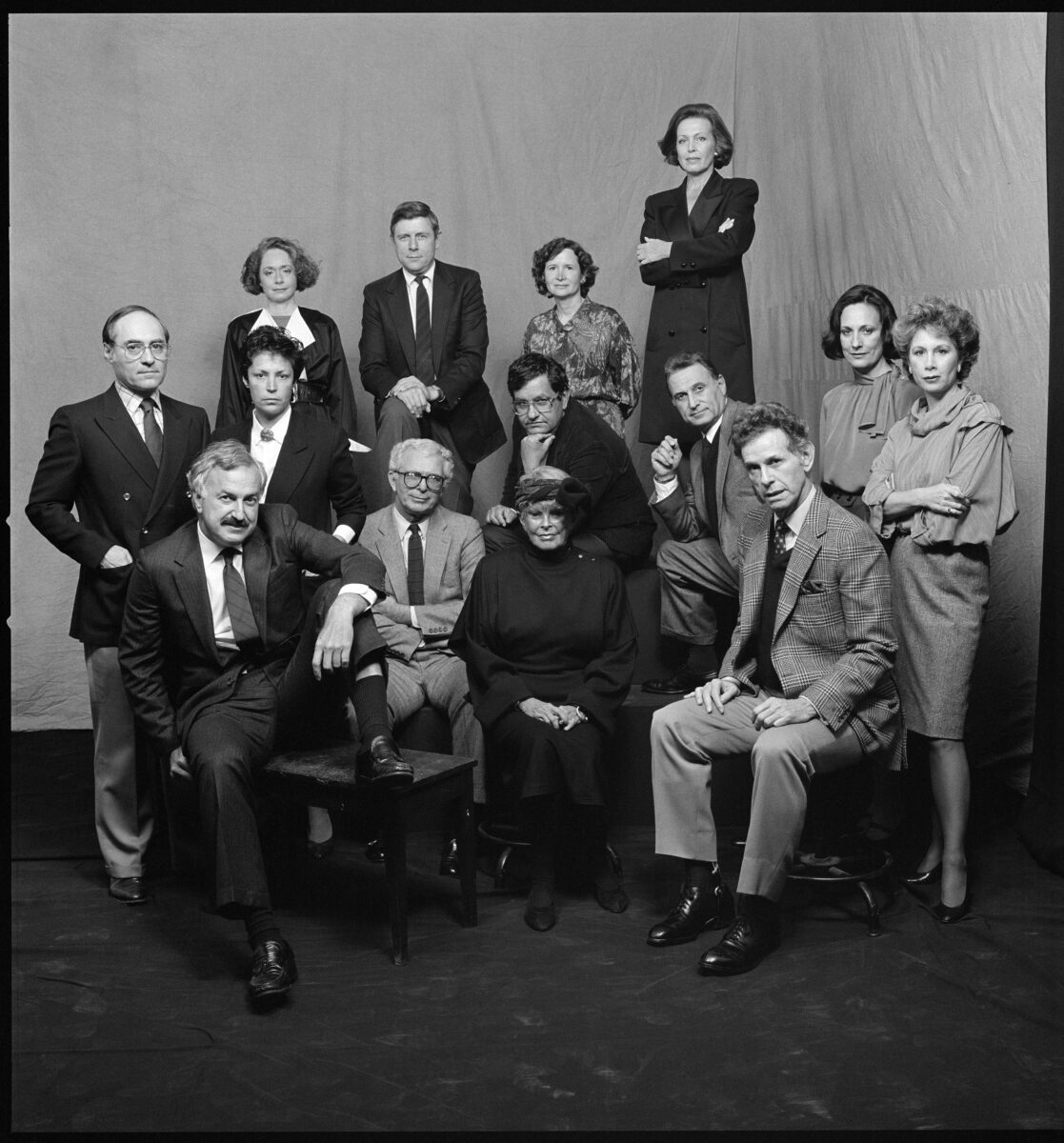
Collecting the New Irascibles: Art in the 1980s, will be on view from Jan. 28 to April 12 at the Arthur Ross Gallery in the Fisher Fine Arts Library building on Penn’s campus. The opening reception is from 5 to 7 p.m. on Friday, Jan. 30.
At the exhibition’s center is Timothy Greenfield-Sanders’s iconic 1985 portrait, New Irascibles Collectors, which presciently enshrined these families as the most ambitious and dedicated supporters of the era’s avant-garde American art scene. Most of the pictured collectors have strong connections to Penn and are the primary lenders of works for the Collecting the New Irascibles exhibition.
“These were new types of collectors, ambitious, audacious, and unafraid to take a chance on an emerging art scene, supporting boundary-pushing artists like Jean-Michel Basquiat, Keith Haring, and David Wojnarowicz, whose work dealt with race, sexuality, and late-capitalist consumer culture,” said Gwendolyn DuBois Shaw, Inaugural Faculty Director of the Arthur Ross Gallery. “They helped make the market for contemporary art as we know it today.”
The East Village was full of empty storefronts with low rents in the 1980s fostering a dynamic arts ecology fueled by ambitious emerging artists, adventurous critics, and intrepid dealers. Collecting the New Irasciblesargues that the central component to this mix was the ongoing support of collectors whose audacious support of challenging—often controversial—art forged long-standing, personal relationships with the artists they championed.
Greenfield-Sanders, a consultant on the exhibition, said his portrait The New Irascibles: Collectors “captures the major players who were buying East Village art at that moment” in the 1980s. “I posed them to mimic the legendary Irascibles photograph by Nina Leen,” he said, referring to the 1950 image, published in Life magazine, of 15 New York–based painters leading that era’s Abstract Expressionist movement.
“When I first saw Timothy Greenfield-Sanders’ portrait of the New Irascibles: Collectors, I was struck by the fact that nearly all the people pictured in this remarkable photograph had some connection to Penn. They are either Penn alumni themselves, or some of their children and grandchildren went to Penn,” said Shaw, who is also the James and Nan Farquhar Professor of the History of Art. “Part of a long legacy of Penn alumni with a common Jewish-American heritage that includes members of the Lauder and Annenberg families, the New Irascibles collectors raised the bar for art collecting and cultural philanthropy at the end of the 20th century.”
Included in Collecting the New Irascibles are works loaned by Hubert Neumann (Wharton School 1952); Michael Schwartz (Wharton School 1980), his son Alexander Schwartz (College of Arts & Sciences 2014) and his mother Barbara Schwartz; Lise Spiegel Wilks (College of Arts & Sciences 1980); and Herbert and Lenore Schorr, whose family members have attended both the College of Arts & Sciences and the Wharton School. Also highlighted are works from Miami’s Rubell Family Collection and the estate of Elaine Dannheisser, whose collection is now held by the Museum of Modern Art in New York.
The exhibition features works of art made and collected in New York City between 1981 and 1993, including painting, sculpture, photographs, and works on paper. The 22 artists represented are John Armleder, Jean-Michel Basquiat, Ashley Bickerton, George Condo, Francesco Clemente, Robert Gober, Félix González-Torres, Keith Haring, Jeff Koons, Louise Lawler, Sherrie Levine, Robert Longo, Peter Nagy, Richard Prince, David Salle, Cindy Sherman, Haim Steinbach, Sturtevant, Peter Schuyff, Philip Taaffe, Meyer Vaisman, and David Wojnarowicz.
Contemporary critics gave the avant-garde art of the 1980s and ’90s many names—Postmodernist appropriation, Neo-Expressionism, Neo-Geometric Conceptualism, Post-Graffiti—but essentially the movements signaled a decisive break from past expectations and a full-force tilt toward the “new.” More than four decades later, Collecting the New Irascibles shows the enormous impact of those artists and the legacies of those who collected their work.
Image credit: Timothy Greenfield-Sanders, New Irascibles Collectors (from the series Art World), 1985. Gelatin silver print, 14 in. × 14 in. Courtesy of the artist.
For media inquiries, please contact:
Louisa Shepard
LJS Communications
ljscomms@outlook.com
Miranda Powell
Gallery Coordinator
powellmj@upenn.edu
About the Arthur Ross Gallery:
Founded in 1983, the Arthur Ross Gallery is a faculty-led, multidisciplinary exhibition space dedicated to showcasing art of all kinds. Located in the Fisher Fine Arts Library building at the heart of the University of Pennsylvania’s campus, the Gallery is open to the public and admission is free. Hours: Monday, Tuesday, Thursday, Friday, 10 a.m. to 5 p.m.; Wednesday, 11 a.m. to 6 p.m.; Saturday and Sunday, noon to 5 p.m. Learn more at ArthurRossGallery.org.
Arthur Ross Gallery | 220 S. 34th Street, Philadelphia, PA 19104
Phone 215-898-2083; Gallery front desk: 215-898-1479