Three generations of the Schwartz family loans artworks for the Arthur Ross Gallery’s exhibition Collecting the New Irascibles: Art from the 1980s
March 6, 2026
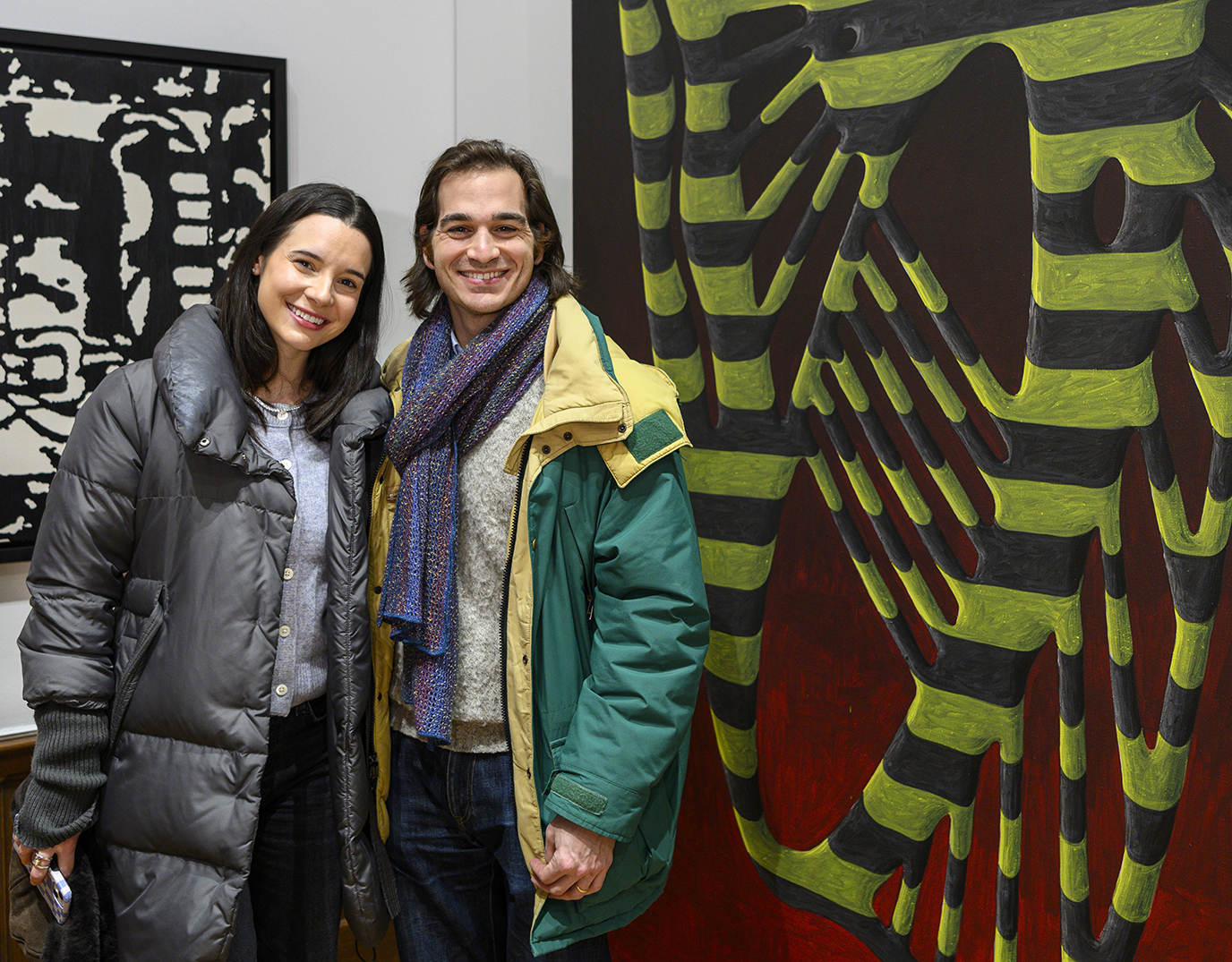
Alexander Schwartz and his wife, Lizzy Schwartz next to the painting (right) they loaned, Joe Cool (1984) by artist Peter Schyuff, to the Arthur Ross Gallery exhibition Collecting the New Irascibles: Art in the 1980s.
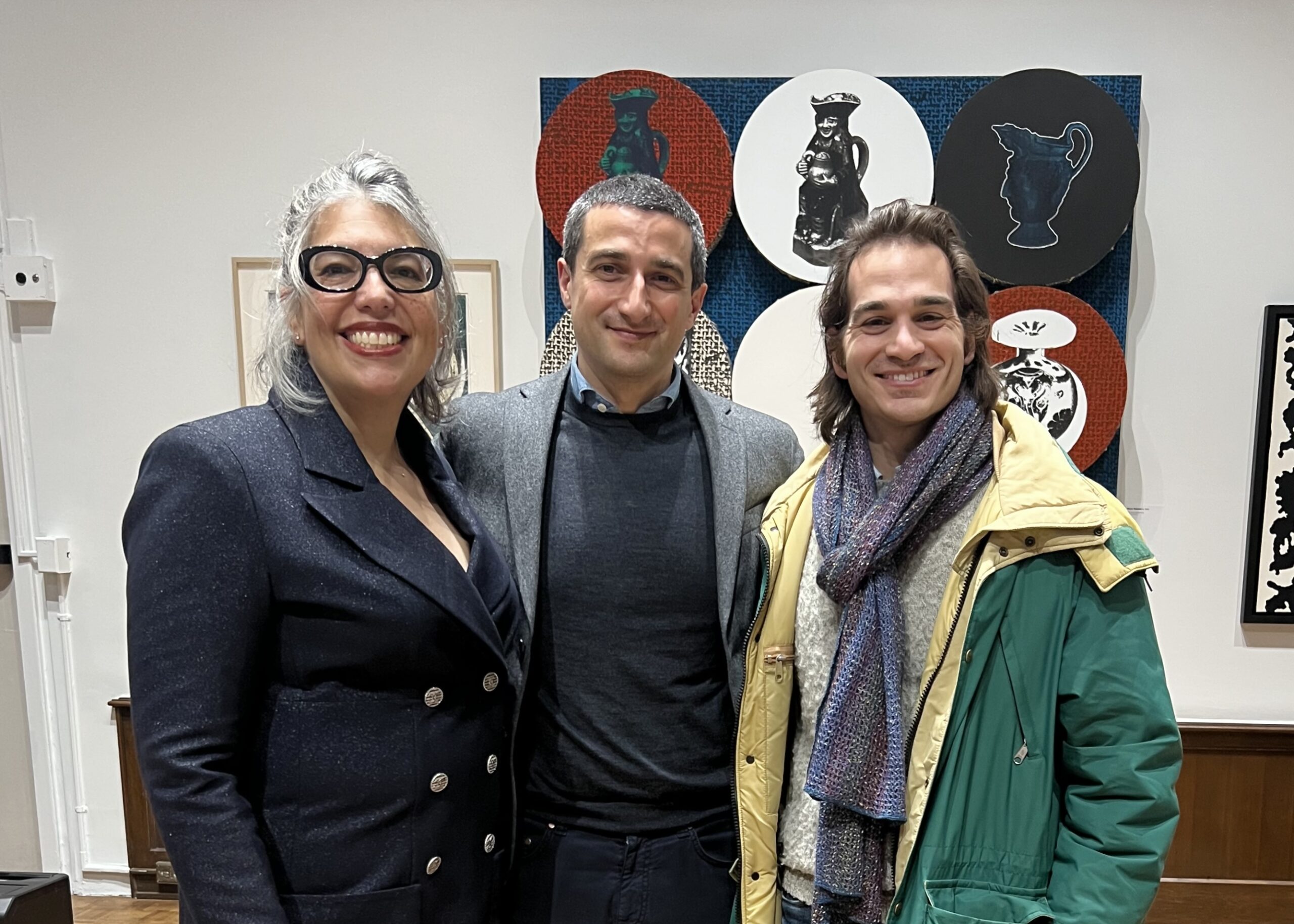
(From left) Gwendolyn DuBois Shaw of the Arthur Ross Gallery with Penn alums David Galperin, of Sotheby’s, and Alexander Schwartz, at the exhibition opening.
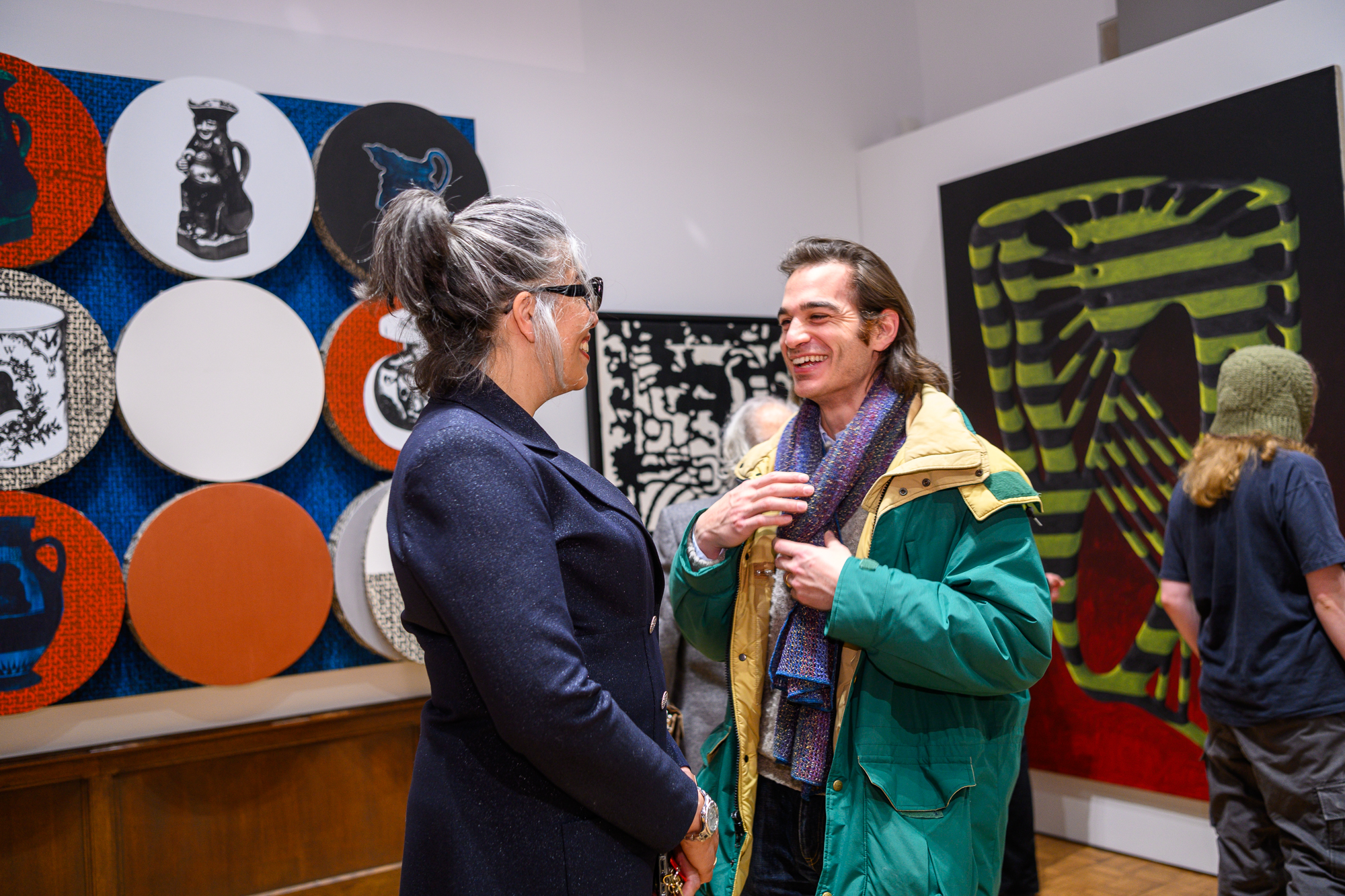
Alexander Schwartz (right) talks with Gwendolyn DuBois Shaw, who was his Penn professor and academic advisor.
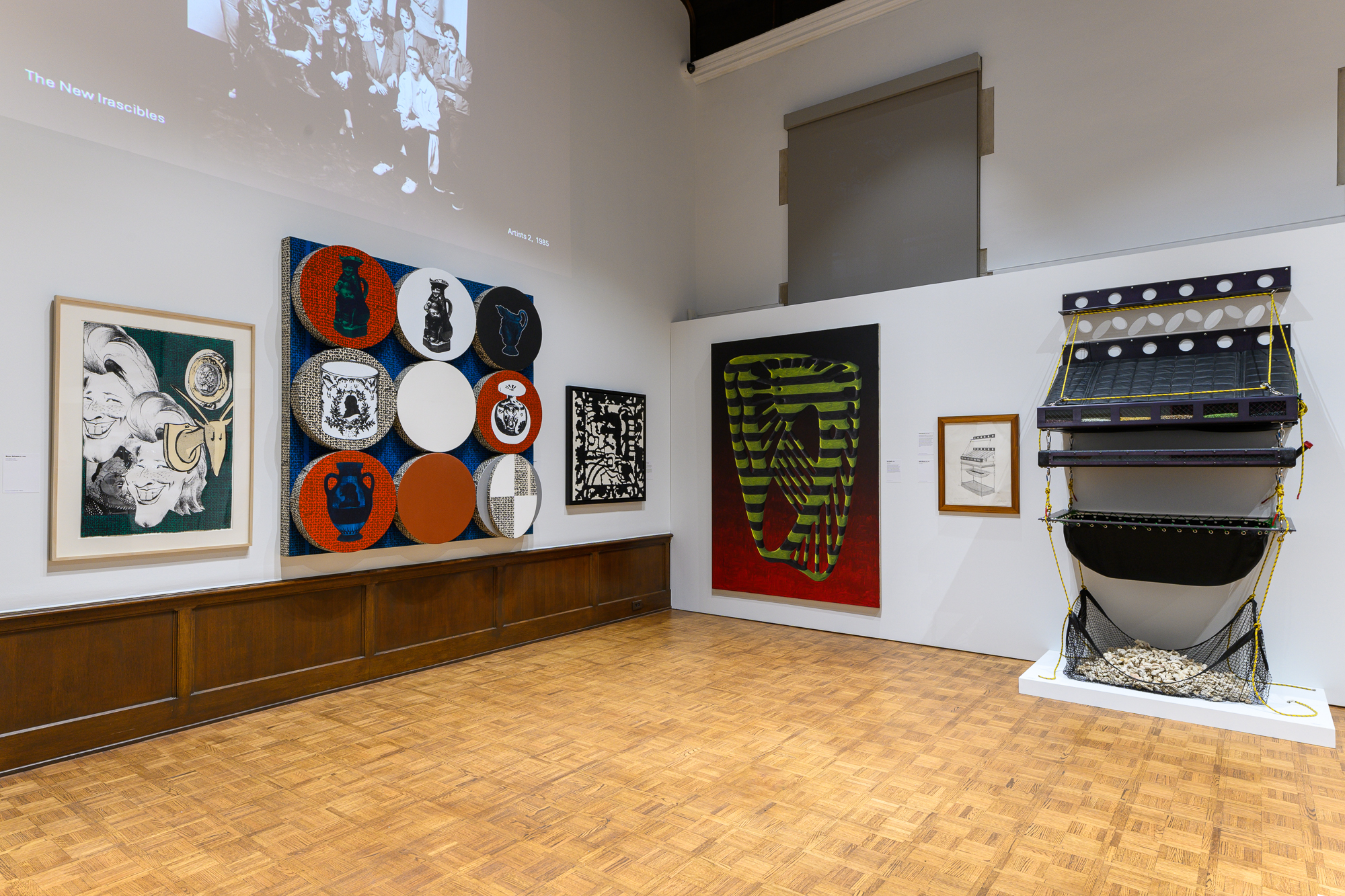
The Peter Schyuff painting on loan by Alexander Schwartz (right) is on view next to two paintings on loan by his father, Michael Schwartz, on the adjacent wall, one by Peter Nagy and the other by Meyer Vaisman.
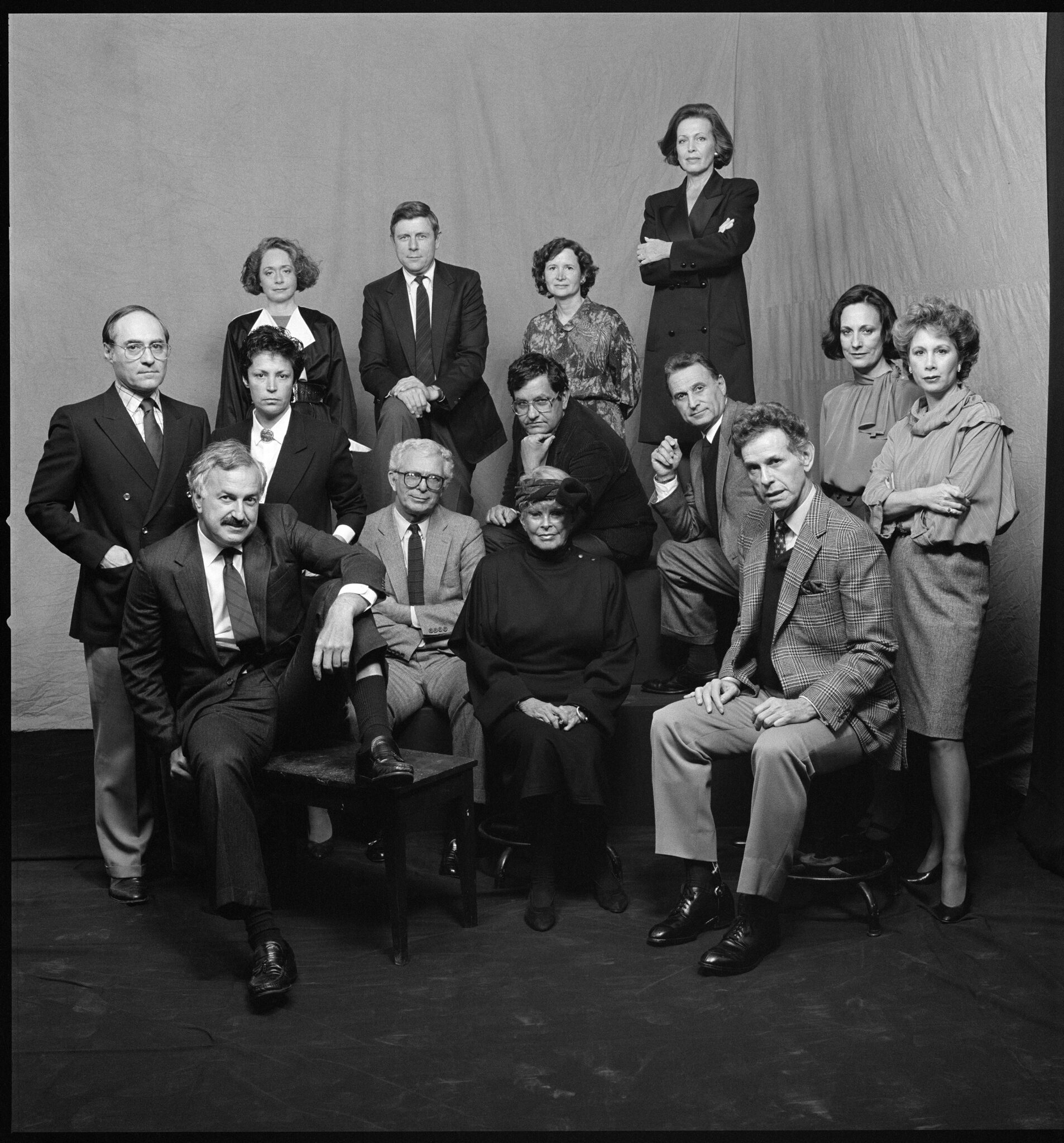
Alexander Schwartz’s grandparents, Barbara Schwartz (second from right, standing) and Eugene Schwartz (right, seated), were among 14 art collectors in a photo taken in 1985 by Timothy Greenfield-Sanders, New Irascibles Collectors (from the series Art World). (Gelatin silver print, 14 in. × 14 in. Courtesy of the artist.)
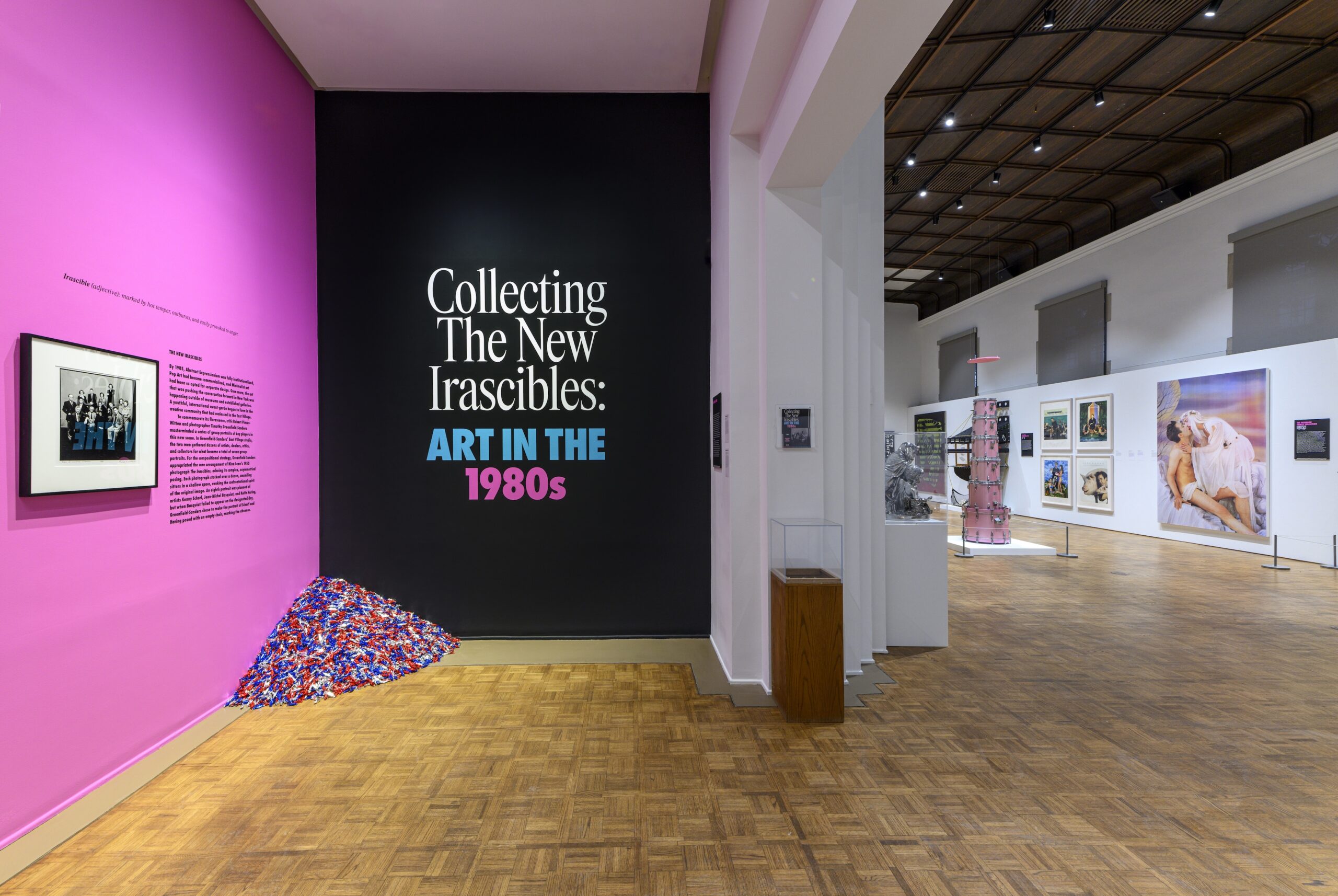
The exhibition Collecting the New Irascibles: Art in the 1980s is on view through April 12, 2026.
Penn alum Alexander Schwartz, College of Arts & Sciences Class of 2014, describes living with world-class artworks.
As the story goes, during an interview for a Manhattan nursery school, when Alexander Schwartz got to the letter V while responding to alphabet flashcards he said the vacuum cleaner shown with the letter was “art,” which made perfect sense because in his home’s front hallway was a sculpture by artist Jeff Koons featuring a series of vacuum cleaners in a glass case.
“I said art because that’s what I associated it with,” Schwartz said in a video interview from his home in New York City. “I grew up in a family of art collectors.”
He did not get into the preschool, but he did get into the University of Pennsylvania, where he studied art history, graduating from the College of Arts & Sciences in 2014. Now a painting he owns is in the Arthur Ross Gallery, on loan for the current exhibition, Collecting the New Irascibles: Art in the 1980s, alongside artworks on loan from his parents and his grandmother. The exhibition features 32 works by 22 artists, most on public view for the first time, on loan from five families, most with an alumni connection to Penn.
At the center of the exhibition is an iconic 1985 photograph New Irascibles Collectors, taken by Timothy Greenfield-Sanders, of that era’s collectors of Modern and Contemporary art in Manhattan’s East Village. Alex’s grandmother, Barbara Schwartz, who loaned four works to the exhibition, is one of those 14 collectors pictured, along with her late husband, Eugene Schwartz. Alex’s father, Michael Schwartz, who earned his bachelor’s degree from the Wharton School in 1980, and his mother, Barbara Z. Schwartz, who earned an MBA from Wharton in 1985, loaned three works. Alex and his wife Lizzy loaned Joe Cool (1984) an acrylic on linen by artist Peter Schyuff.
“They’ve been so generous, with their art, and with time telling me their stories,” said exhibition curator Gwendolyn DuBois Shaw, the Inaugural Faculty Director of the Arthur Ross Gallery.
Drawn to art history
Shaw, the James and Nan Wagner Farquhar Professor of History of Art, taught Alex Schwartz in multiple courses, and was his academic advisor. “Alex has to be one of the three or four students from that period who I remember most vividly,” said Shaw. “He was always seated up toward the front, taking notes, asking questions.”
When Shaw started working on the exhibition and researching the families in the Greenfield-Sanders portrait she learned from Schwartz’s classmate David Galperin, now Vice Chair and Head of Contemporary Art at Sotheby’s, that the two Schwartzes in the picture were Alex’s grandparents. “I thought, wow, this explains so much about his genuine interest in art history,” Shaw said.
“I’ve always loved art. It’s part of my family history,” Schwartz said, explaining his choice to major in art history. “I didn’t want to work in the art world, but I told myself that I could separate my academic interest from my professional interest, and that turned out to be true. I really loved the art history program.”
Schwartz now works in private equity. “I find my art history degree to be totally practical. The strong written and oral skills and analytics, they have served me well,” he said. “And my love of art persists. It’s great to be able to go to a museum, go to someone’s house, and have a feel for what you’re looking at.”
He lives in Brooklyn with his wife, Lizzy Schwartz, and their toddler son. Not surprisingly, their home is filled with works of art.
“I do consider myself somewhat of an art collector, but I’m definitely more of an art lover,” Schwartz said. “I think that, like anything, there are levels to it. I wouldn’t say I’m an art collector like my parents are, or my grandparents. But I love to live with art.”
Many of the artworks in his home are on loan from his parents and his grandmother, but he is making acquisitions of his own as well.
“I’m looking around our room, and one piece is my parents’, two pieces are ours that are hanging, and we have two pieces that are on the ground because we’ve run out of wall space,” he says. “I guess that’s a sign that I am, in fact, a collector.”
A contemporary view
His focus is on contemporary artists, the new, the latest. “I’m drawn to a lot of the art that my parents collect,” he said. The most-recent work he purchased is by artist Gao Hang, who creates paintings that “look like they’re almost from a PS1 or PS2, PlayStation video games,” Schwartz says.
Woven throughout the Collecting the Irascibles exhibition are the stories of collectors supporting emerging artists and forming lasting relationships. While at Penn, Schwartz took a course that involved curating an exhibition at Penn’s Institute of Contemporary Art. A local emerging artist included was Alex Da Corte, who has since become well-known. “He did a portrait of me as a student there. He was nice enough to give me the artist proof,” Schwartz says, and he has continued to follow and purchase his work.
Choosing which artworks to lend to the Collecting the Irascibles exhibition was a collaboration, with the Schwartz family offering what they had available and Shaw choosing what she wanted to borrow.
“I think it all looks amazing in the space. Professor Shaw did such a beautiful job; it is so intentional in terms of the grouping of art that’s there, and the context that was provided in the wall details,” Schwartz said. “I think it is really special. And I am so grateful to have been at the opening with Lizzy and to represent the family. I thought it was A-plus.”
Playing ball
What was it like growing up in a home filled with contemporary art? “Well, I don’t know anything different,” Schwartz says.
“I remember being a little kid and thinking, well, that our apartment looked like a gallery in a lot of ways. Which was cool, in hindsight. It wasn’t great for playing ball, I’ll tell you that much. But it was cool,” he said.
“It took me a while to realize how special it was to grow up in that type of environment, to every day wake up and be in and around really thought provoking art that’s beautiful visually, and have it be such a part of our family’s identity,” he says. “It took me a long time not to take it for granted.”
But he did “play” with a ball, specifically a Spalding basketball that is the centerpiece of an installation by Koons, the “One Ball Equilibrium Tank” (1985). The ball, is suspended in the middle of a glass-and-steel tank, filled with distilled water, floating on top of salt water with fresh water on the top.
“If you live with it, every time you walk by the floor moves a little bit and the water mixes. And so over the course of a few weeks, that ball is going to drop because the salt and fresh water mix,” Schwartz said.
He would help his father refill the tank so the ball would be suspended in the center. “It’s very complicated,” he said.
“It would be just my dad and me setting up this piece of art,” he said, noting that a team of professional art handles would manage it in a museum.
Schwartz guesses he was about 10 years old when he started helping with the tank. “I always thought it was so fun,” he said. “An order of like 40 jugs of water would come, and when we were done, we would like sword fight with the empty water cooler jugs.” It was a regular chore, like raking leaves in the backyard; “Okay, let’s go set up the basketball.”
Another chore was the “hours and hours and hours of hanging and unhanging and adjusting pieces of art around the apartment,” he said. “And the measuring and making sure that it’s just the right height and taking out the hooks and putting in the hooks. We’d spend an hour moving a painting up and down like a millimeter. It drove me nuts!”
And even though he said it was incredibly tedious, it was a fun bonding moment in hindsight. Today, he does the same in his apartment. “When we moved in, my dad actually helped me install this,” Schwartz said, pointing to a very large painting by artist Christian Schumann behind where he was sitting. “And we hung it and we both looked at it. It was too low by a lot. And he said, ‘It looks pretty good,’ and I said ‘Are you kidding me? Don’t even try that. You’re not off the hook!’” he said, laughing, “and then we made it look right.”