Computer science combined with a passion for the arts
November 6, 2026
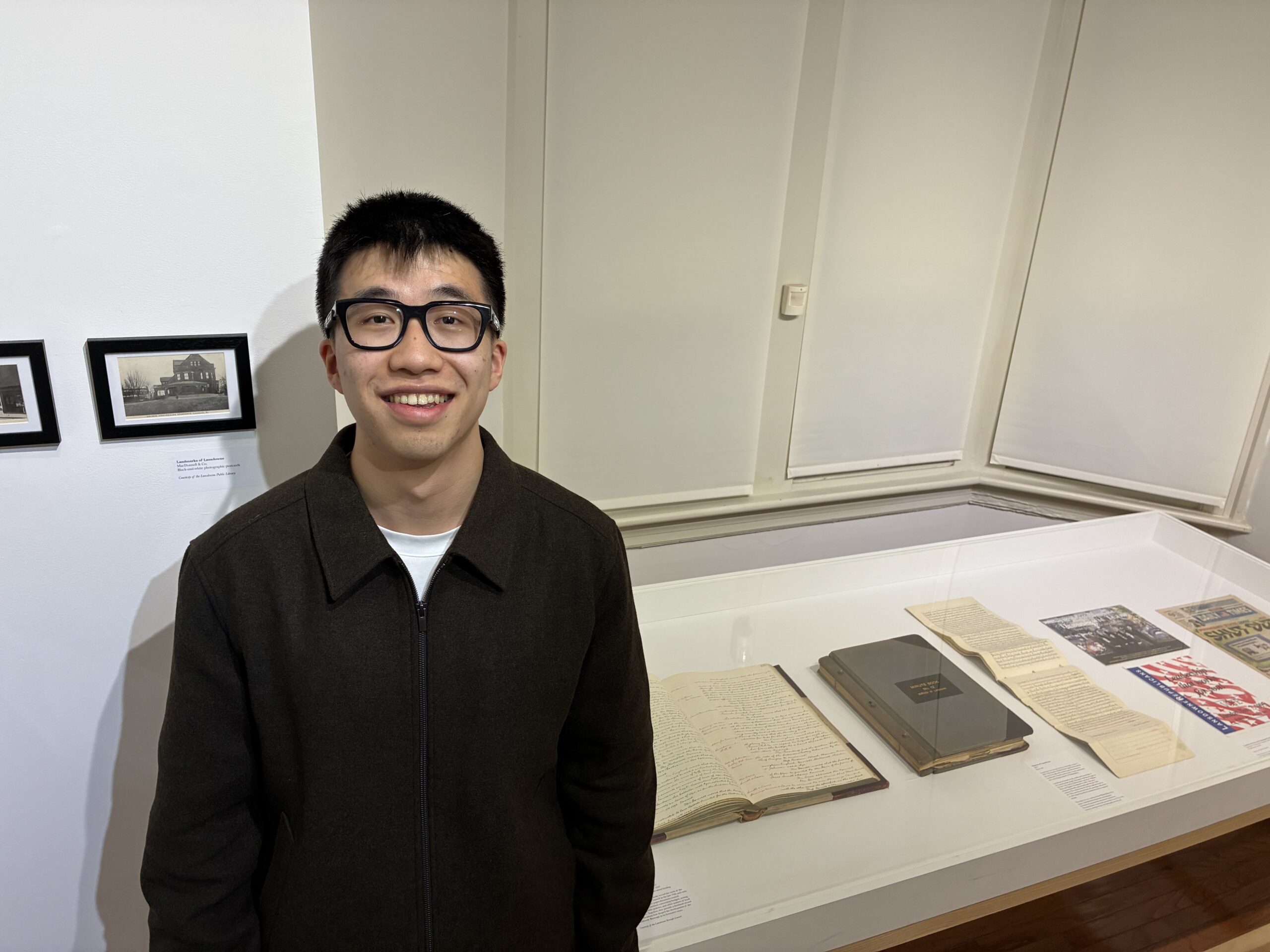
Frank Zhu MCIT’27 at the Landsdowne Arts Committee exhibition, “Stories We Carry”, for which he served as lead curator.
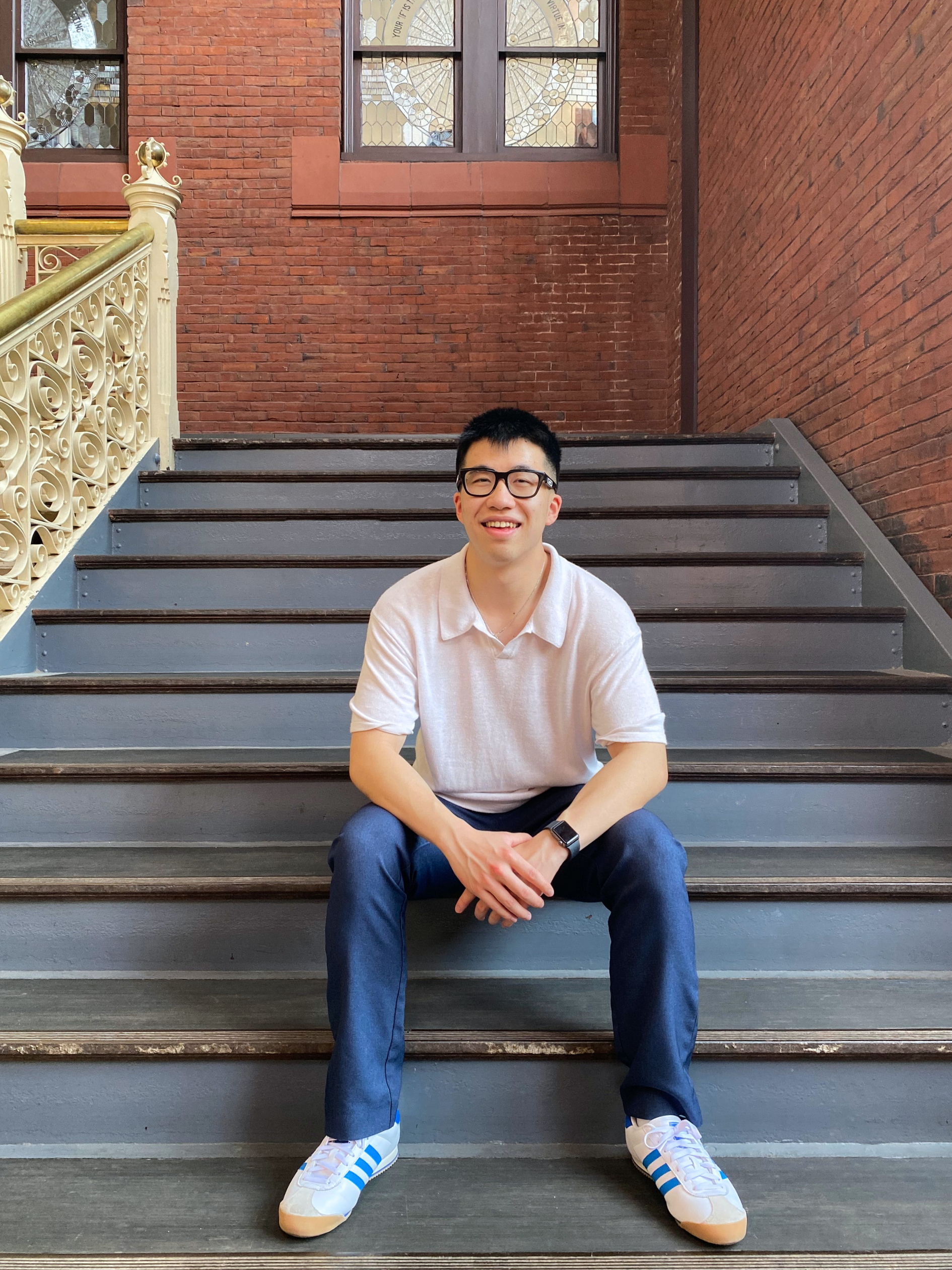
Frank Zhu MCIT’27 on the stairs of the Fisher Fine Arts Library.
Penn Engineering graduate student Frank Zhu volunteers with arts and culture groups on campus and in the community.
From liberal arts to computer science, Frank Zhu has charted a varied and adventurous path. But it wasn’t until he came to the University of Pennsylvania that he discovered his passion for the visual arts, starting at the Arthur Ross Gallery.
Zhu is in his second year of the Master of Applied Science in Computer Science program at Penn Engineering, and is set to graduate in May. He joined the Arthur Ross Gallery’s volunteer Student Advisory Board within weeks of arriving at Penn.
“The Arthur Ross Gallery is really a springboard for me into the broader art scene across campus and in Philly,” Zhu said. “It has been really fascinating to me to see the ins and outs of a gallery organization. And that drove me to become even more involved.”
Zhu also has joined groups at the Penn Museum and The Barnes Foundation. And he is the volunteer curator of an exhibition currently on view in a gallery in Lansdowne, Pennsylvania, just outside Philadelphia.
“I think it’s marvelous what Frank is doing with the arts on campus and in the community,” said Gwendolyn DuBois Shaw, the Arthur Ross Gallery Inaugural Faculty Director. “He’s pursing an engineering degree, but the arts are such a central part of his life.”
Shaw said Zhu is a natural leader on the Student Advisory Board. “He’s very interested in collective equality and everyone having a say, and he’s been very active in volunteering, supporting programming and receptions,” said Shaw, the James and Nan Wagner Farquhar Professor of History of Art. “He supports our events in any way he can; set up, clean up, coat check, all-hands-on-deck.”
Miranda Powell, Arthur Ross Gallery Coordinator, is the staff liaison to the student board. “Frank’s passion is really immense for the arts and he shows it through attendance at almost all of our events, and sharing and spreading the word through the student body, not only through his friends, but with the other organizations that he’s part of, and just always being here as a helping hand,” Powell said. “And he does it always with a smile and so much grace. He’s just a joy to be around. He’s definitely a star on the board.”
Discovering the visual arts
Zhu was born and raised in Calgary, Canada, in the province of Alberta. He started taking piano lessons when he was about four years old. “Piano was my first foray into art. And it was something that I practiced extensively throughout my childhood, and even now,” Zhu said. He also has studied music theory and music history, which, he said “really opened my eyes to the progression of human ideas and culture and different social issues across different periods.”
Zhu earned his undergraduate degree from Arts & Science, an interdisciplinary liberal arts program at McMaster University in Canada, alongside a combined honors in business. He gained experience with technology across an eclectic range of fields, including drone surveying, finance, and even a stint at a wilderness resort in the Arctic. “I realized I wanted computer science as part of my formal education,” he said, which led him to Penn.
While growing up, his family traveled across Canada, the United States, Asia, and Europe. “Whenever we went on vacation as a family, we always made sure to visit museums,” he said.
But it wasn’t until he came to Philadelphia that he realized how he could become involved in the arts beyond music and literature. Before his first semester at Penn, Zhu was a residential counselor in the Engineering Summer Academy and started researching student clubs and activities.
“The Arthur Ross Gallery is very special to me because it’s the very first encounter with the visual arts I’ve had at Penn,” Zhu said. “The Student Advisory Board stood out to me because it isn’t entirely student run; employees and professionals and experts are involved. And it seemed like a good combination of the social sciences and the liberal arts.”
The events are the best part, he said, especially those organized by the student board. “It’s such a joyous and bustling social environment to meet with other students,” Zhu said.
“Despite being in different years and having different majors, we all share this common passion for the arts,” he continued. “We are able to share ideas about the arts and introduce each other to our friends. I think it’s such a rare and precious opportunity that just does not exist when you’re going through your day-to-day classes.”
The board-organized student event in the spring has been growing in popularity and engagement over the last couple years, Powell said, and it was Zhu’s idea to hold a social at the end of the year for the board members. “He’s this great connector in the group,” Powell said. “He’s always the one that everyone already knows somehow.”
An idea Zhu just proposed is for the board members to visit museums or galleries in Philadelphia together, especially First Friday events.
Expanding involvement
Zhu has embraced the “rich cultural scene” in Philadelphia, visiting museums and galleries and becoming involved. The Arthur Ross Gallery has helped Zhu make those connections. “A university gallery can be a bridge to the larger arts ecology of the city, and at the Arthur Ross Gallery we support students making those connections. Frank exemplifies what Penn students make possible when they engage deeply with regional cultural life,” said Emily Zimmerman, Director of Exhibitions and Curatorial Affairs.
At the Penn Museum he is a member of the Graduate Advisory Council, a professional research group of students, primarily in archaeology and anthropology. And he gives hour-long tours as a Graduate Guide at the Museum a couple times a month. This academic year he is doing a part-time assistantship, part of a digital archaeology project about Bartram’s Garden in Southwest Philadelphia.
He also joined the Barnes Foundation’s Contemporaries Council, a group of young professional members who attend programming at the Barnes and across Philadelphia.
And in the summer Zhu volunteered for the Lansdowne Arts Committee, working with the 20*20 Gallery, located in a 19th-century home in the historic borough. Zhu started as an intern in May, and because of staff changes became the lead curator of the current exhibition.
The Stories We Carry exhibition, on view through Dec. 20, ties into America 250. “It’s a really comprehensive look at the history of the borough of Lansdowne and how it’s evolved,” Zhu said.
The three sections include family life and culture; civic engagement, commerce, and government; and maps, including issues related to civil rights. Zhu said he worked with the gallery staff to choose the content and then conducted research and outreach to find the artifacts, including at the Lansdowne Borough Council, The Athenaeum of Philadelphia, and the Lansdowne Public Library, as well as from local artists and residents. He helped decide how to arrange the exhibition and wrote the wall labels based on his research.
The experience has given him insight into the work that goes into curating and mounting an exhibition. “Now every time I go to a gallery or a museum, I pay attention to not only the artists but also to the curators who made the show possible,” he said. “And I have gotten into the habit to more actively talk to the curators and ask them about their ideas and what really drives their vision for the exhibition.”
Art and Science
The arts are compatible with computer science, also a broad field with many avenues, Zhu said. “I’m really fascinated by how machines and computers process things visually,” he said.
Interpreting visual cues using digital methods was his first introduction to computer science, he said. During his undergraduate years he worked flying drones to take photos of shipping cargo and used software to calculate the volume. “I think there is a good combination between how we see things visually, how we interpret visual arts, and ways to engage that on the computer side,” he said.
Zhu is taking a course in human-computer interaction, which he said is related to the visual design of digital interfaces such as apps or websites. He also is studying computer vision, which he said is a subset of artificial intelligence and machine learning, involving training computers to recognize visual objects.
After graduation, Zhu said he hopes to find a computer-based job in a cultural institution, such as a museum. He also may pursue a Ph.D. in human-computer interaction, in an interdisciplinary program that requires knowledge in both the creative and the computer fields.
Zhu thinks a lot about artificial intelligence and what it means for the future. “I think reconnecting with the arts and taking time for yourself and asking these questions of what it really means to be happy or what truly constitutes a good life,” he said. “I think you can only obtain that through the arts.”